

A monumental shift is reshaping the global economy. In a sudden, high-stakes diplomatic development, United States President Donald Trump announced via official channels that a comprehensive peace agreement between the United States and Iran is scheduled to be finalized and signed today, Sunday, June 14, 2026. Negotiated through intensive bilateral and multilateral mediation channels—primarily spearheaded by Pakistan—this breakthrough marks the definitive end to months of intense military escalation and economic paralysis in the Middle East.
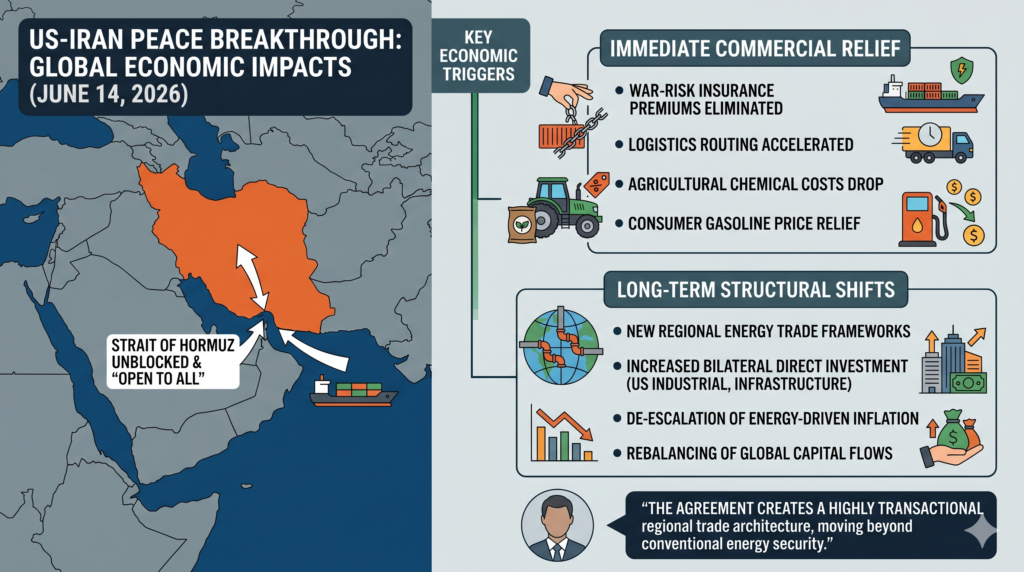
The structural core of the announcement carries immediate commercial weight: the strategic Strait of Hormuz will be fully unblocked and declared “open to all” immediately upon the formal signing of the memorandum of understanding (MoU). For corporate supply chain managers, global logistics networks, and macro investors, the sudden reopening of this vital choke point—which handles more than 20% of the world’s petroleum liquids—represents the single most impactful market event of 2026. It reverses a severe wartime premium that has depressed global consumer sentiment, spiked domestic inflation, and disrupted international trade routes for months.
Inside the Accord: De-escalation and Nuclear Reclassification
The diplomatic framework driving this sudden market realignment comes after a highly volatile sequence of geopolitical maneuvers. Following a localized ceasefire brokered in April, multi-party negotiations entered an expedited phase in Islamabad. According to official briefings from Pakistan’s Prime Minister Shehbaz Sharif, negotiations concluded their final phase over the weekend, positioning both nations on the precipice of a historic economic pivot.
While Iran’s Foreign Ministry spokesperson, Esmaeil Baghaei, cautioned that the immediate focus of the finalized Islamabad MoU centers strictly on the total cessation of hostilities and the swift restoration of maritime transit rights, the White House has already laid out structural parameters regarding long-term security. Under the newly defined framework, the United States is implementing direct mechanisms regarding regional military stability and atomic materials.
In an official public statement, the executive branch confirmed that Iran will explicitly step back from its nuclear weapons ambitions, completely halting the purchase, independent development, or external procurement of enriched materials. Furthermore, the administration detailed a systematic verification blueprint: at an appropriate tactical window, U.S. forces are slated to downblend and safely destroy existing subsurface enriched uranium reserves, establishing a permanent non-proliferation barrier.
Macro Economic Impacts: Reversing the Inflation Shock
The commercial and financial fallout from the prolonged blockade has been deeply felt throughout the U.S. domestic economy. The sudden resolution of the conflict provides an immediate relief valve for multiple macroeconomic pressure points:
1. The Realized Crude Slump and Retail Fuel Relief
Throughout the second quarter of 2026, global crude benchmarks routinely hovered at highly restrictive levels, driving domestic regular grade gasoline to an average of $4.49 per gallon heading into the summer travel season—a staggering 42% surge compared to previous baselines. This energy shock functioned as a massive border-cost tax on American consumers, depressing the University of Michigan consumer sentiment index to fresh historic lows.
Early market indications reveal that crude futures are already sliding sharply in Sunday electronic trading. The structural return of stable Persian Gulf tanker transits is projected to quickly deflate the built-in geopolitical risk premium, bringing immediate margin relief to transport logistics, consumer discretionaries, and industrial manufacturing sectors.
2. The Federal Reserve’s Monetary Policy Re-Route
The peace accord fundamentally reshapes the trajectory of the Federal Reserve under newly confirmed Chair Kevin Warsh. Up until this weekend, mounting wholesale prices—exemplified by a hot 1.4% surge in the Producer Price Index (PPI) and a sticky 3.8% headline Consumer Price Index (CPI) annualized rate—had forced the fed funds futures market to price in mandatory interest rate hikes by December 2026 to combat wartime inflation.
With energy inputs poised to contract significantly, the supply-side shock is expected to cool down rapidly. This macro deceleration gives the Federal Reserve immediate breathing room to pause its restrictive monetary tightening cycle, stabilizing the 10-year Treasury yield, which had previously spiked past 4.47% amid persistent inflation fears.
Industry Analysis: Winners, Losers, and Capital Shifting
| Market Sector | Immediate Operational Impact | Strategic Forward Outlook |
| Global Maritime & Shipping | Elimination of war-risk insurance premiums; direct access to shorter, low-cost deepwater lanes. | Massive surge in maritime asset utilization; rapid normalization of international spot freight rates. |
| Agricultural Chemicals | Relief for global natural gas networks, which had spiked processing costs. | Anhydrous ammonia prices are expected to drop below their wartime high of $900 per ton, lowering farming input costs. |
| Domestic Energy Primes | Compression of the localized geopolitical risk premium that artificially inflated crude revenue. | Shift away from short-term price plays back toward high-efficiency, long-term capital expenditure models. |
The Structural Reality: A New Middle Eastern Trade Architecture
While mainstream financial reporting focuses heavily on the immediate downward drop in retail gasoline prices, institutional risk managers are tracking a far deeper structural transformation. The Islamabad MoU does not simply restore the pre-war status quo; it establishes a highly transactional, updated regional trade framework.
The United States has explicitly coupled maritime transit security with broader cross-border infrastructure initiatives. By normalizing commercial lanes through the Strait of Hormuz, the administration is laying the groundwork for updated, multi-lateral energy trade frameworks spanning across the Middle East, South Asia, and Western markets.
This transactional diplomacy mirrors recent executive economic strategies executed during the recent U.S.-China summit in Beijing, where trade friction was rapidly substituted for large-scale corporate procurement mandates, such as China’s massive 200-plane order from Boeing. Foreign ministries throughout the Gulf are expected to quickly transition toward targeted direct investment pacts in American industrial manufacturing and infrastructure corridors in exchange for permanent zero-rate tariff allocations.
Conclusion
The signing of the US-Iran peace accord marks the definitive resolution of the most dangerous economic bottleneck of 2026. By instantly unblocking the Strait of Hormuz, the agreement removes the severe energy-driven inflation threat that was systematically eroding American corporate margins and consumer purchasing power. As global commodity markets swiftly reprice to adapt to a post-conflict baseline, the domestic investment landscape will pivot away from defensive inflation hedges and channel capital directly back into high-growth technology, long-term infrastructure, and consumer-facing equities.